Shifting Loyalty Triggers in Event-Driven Slot Ecosystems Across Global Time Zones
Klara Hoffmann · Jul 23, 2026
Shifting Loyalty Triggers in Event-Driven Slot Ecosystems Across Global Time Zones
Event-driven slot ecosystems rely on loyalty triggers that activate based on player behavior, time-specific promotions, and synchronized global events, and these systems must account for the way different time zones alter participation patterns. Operators adjust trigger windows so that a bonus round tied to a daily reset in one region does not miss peak activity hours elsewhere, while data platforms track login clusters to fine-tune when loyalty points multiply or when exclusive reel features unlock. Research indicates that staggered trigger schedules improve retention rates because players in Asia-Pacific markets often engage during evening hours that align with morning resets in European servers.
Core Mechanics of Event-Driven Loyalty Systems
Slot platforms structure loyalty triggers around measurable events such as consecutive spin streaks, deposit milestones, and tournament entries, yet the timing of these events shifts when servers serve users across continents. A trigger that awards extra free spins after ten spins in a row might activate at 20:00 UTC for European players while teh same rule set rolls out at 08:00 local time for Australian accounts, and backend systems use geolocation flags to enforce the correct sequence. Figures from industry reports show that platforms running unified global clocks experience higher completion rates for multi-stage loyalty challenges because players receive notifications calibrated to their local peak hours rather than a single server time.
Event triggers also incorporate seasonal or promotional overlays, so a loyalty multiplier tied to a summer festival can appear at different calendar dates depending on the hemisphere. Observers note that operators coordinate these overlays through centralized event engines that push updates in rolling waves, ensuring that a July 2026 campaign celebrating major sporting finals reaches North American users during their afternoon slot sessions and Asian users during their evening windows without overlapping server maintenance periods.
Time Zone Synchronization and Player Behavior Data
Player activity logs reveal distinct engagement clusters that operators map against standard time zone offsets, and loyalty engines use these clusters to reposition trigger conditions dynamically. When a cluster in the Eastern Standard Time zone shows heavy play between 19:00 and 23:00 local, the system may advance a loyalty level-up notification by two hours to capture the rising curve, whereas the same notification delays for Pacific Standard Time users whose activity peaks later. Data from the Victorian Responsible Gambling Foundation indicates that synchronized timing reduces abandoned loyalty progress bars by aligning reward delivery with natural session lengths observed in each region.
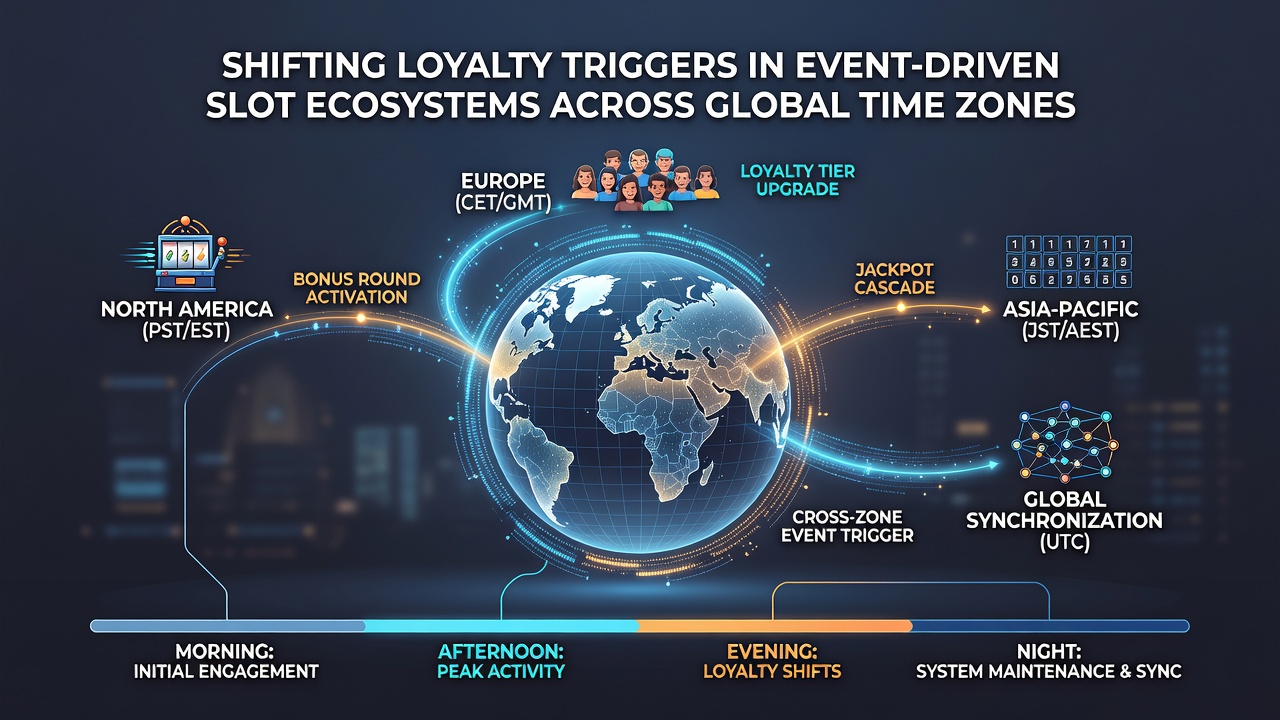
Cross-border tournaments add another layer because entry windows must remain open long enough for participants in distant zones to qualify without extending into low-traffic periods. Platforms therefore divide tournament brackets by rolling time bands, each band carrying its own loyalty bonus pool that resets at the close of the local window. Researchers at the University of Nevada, Reno documented that bracketed entry systems increase total loyalty point redemption when the reset occurs at 02:00 local time rather than a fixed UTC cutoff, because players finish their sessions before the next band opens.
Regional Regulatory Influences on Trigger Design
Regulatory frameworks in different jurisdictions require loyalty triggers to include responsible gaming pauses and spending caps, and these requirements force operators to adapt event timing further. Canadian provincial regulators, for example, mandate that any loyalty multiplier exceeding a defined threshold must include an explicit cooling-off message delivered at the moment the trigger activates, and platforms schedule the message to appear during the player’s typical session length rather than at a universal hour. Similar rules in Australian states require that time-limited loyalty events display remaining duration in the user’s local format, which necessitates precise time zone detection at the account level.
Operators maintain separate rule sets for each regulated market while sharing the same underlying event engine, and compliance teams run automated audits that verify trigger logic against local statutes before each global rollout. The result is a system that appears seamless to players yet contains multiple parallel rule layers that activate according to account registration jurisdiction and current time zone.
Implementation Patterns Observed in July 2026
During July 2026 several major platforms expanded their event engines to include real-time offset adjustments that respond to daylight saving changes across hemispheres, and these updates coincided with the launch of new loyalty tiers tied to international esports finals. The adjustments allowed a single promotional event to trigger loyalty rewards at staggered intervals that matched the broadcast schedules of the finals in each participating region. Platform telemetry showed that participation in the associated slot challenges rose when the loyalty trigger window opened one hour before the local broadcast start rather than at a fixed global time.
Technicians achieved the synchronization by embedding offset tables that update automatically when regional clocks change, and the same tables govern when daily loyalty resets occur for accounts in areas that observe or skip daylight saving. This approach eliminated the previous pattern where players in certain zones repeatedly missed the first hour of a new event because the trigger had already advanced on the server clock.
Conclusion
Shifting loyalty triggers in event-driven slot ecosystems depend on precise coordination between player activity data, regulatory constraints, and time zone mathematics, and platforms that refine these elements continue to record measurable differences in retention across global markets. The July 2026 updates demonstrated that dynamic offset handling can align loyalty events with both regulatory windows and natural player rhythms, while regional rule layers ensure that the same underlying event engine satisfies multiple jurisdictions without requiring separate codebases. As more operators adopt rolling time-band structures and geolocation-aware notifications, the underlying data patterns suggest that loyalty completion rates will continue to track closely with the accuracy of each platform’s time zone mapping.